 AQI Team
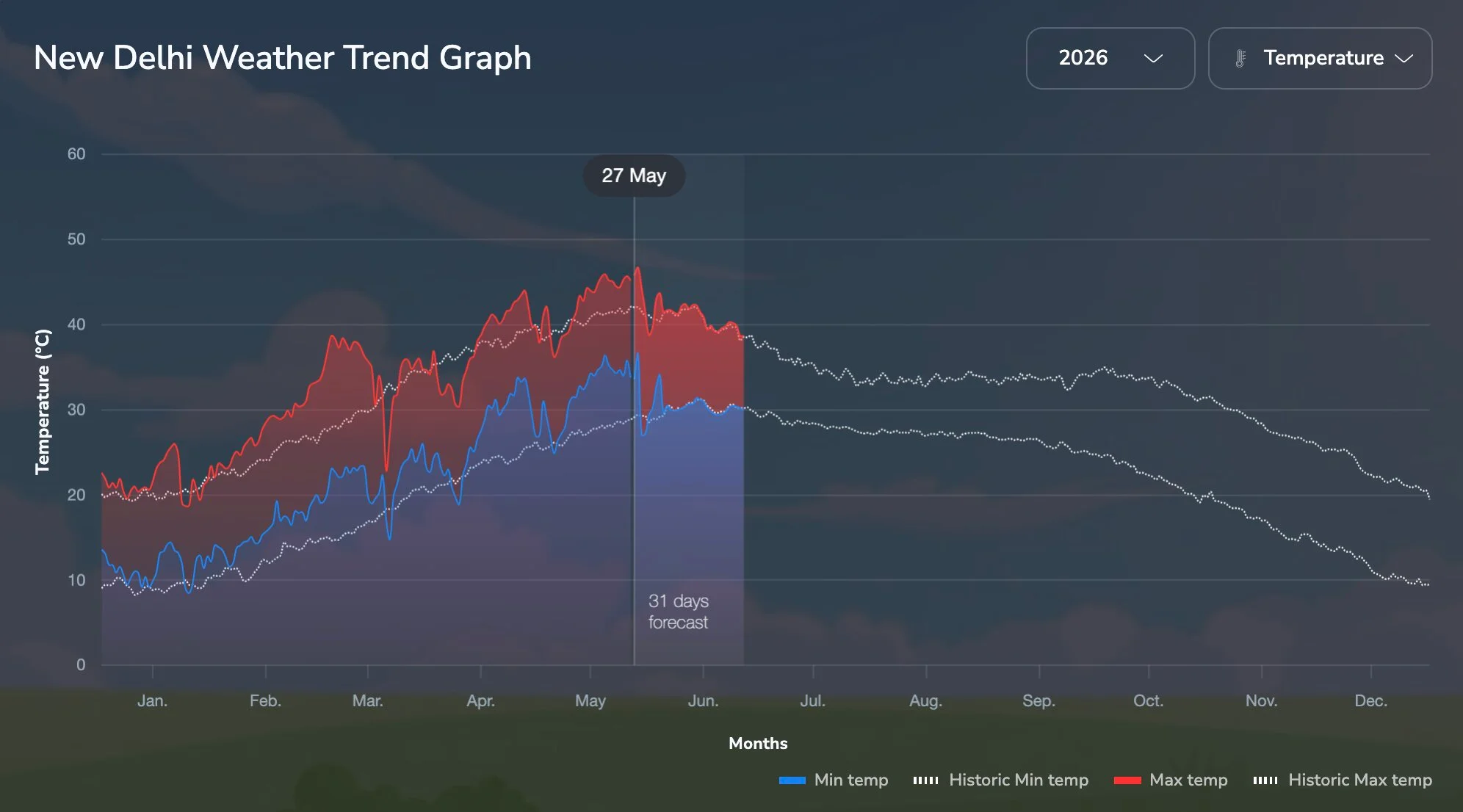
As New Delhi moves through the final days of May 2026, residents are witnessing a severe and historic phase of summer intensification. To understand the shifting baseline thresholds transforming the capital’s microclimate, we conducted a rigorous re-analysis of long-term meteorological records. By isolating daily tracking statistics strictly for the month of May across a 17-year timeline (2010–2026), this targeted Delhi temperature data study highlights an alarming trend: while daytime heat remains intensely punishing, it is the complete evaporation of nighttime cooling that has re-written the record books this season.
1. Extreme Daytime Maximums in the Delhi’s May Temperature Data
A long-term view of daytime maximum temperatures confirms that May has always been New Delhi’s most intense summer month. The historical data records how afternoon limits have steadily pushed higher over the last two decades:
-
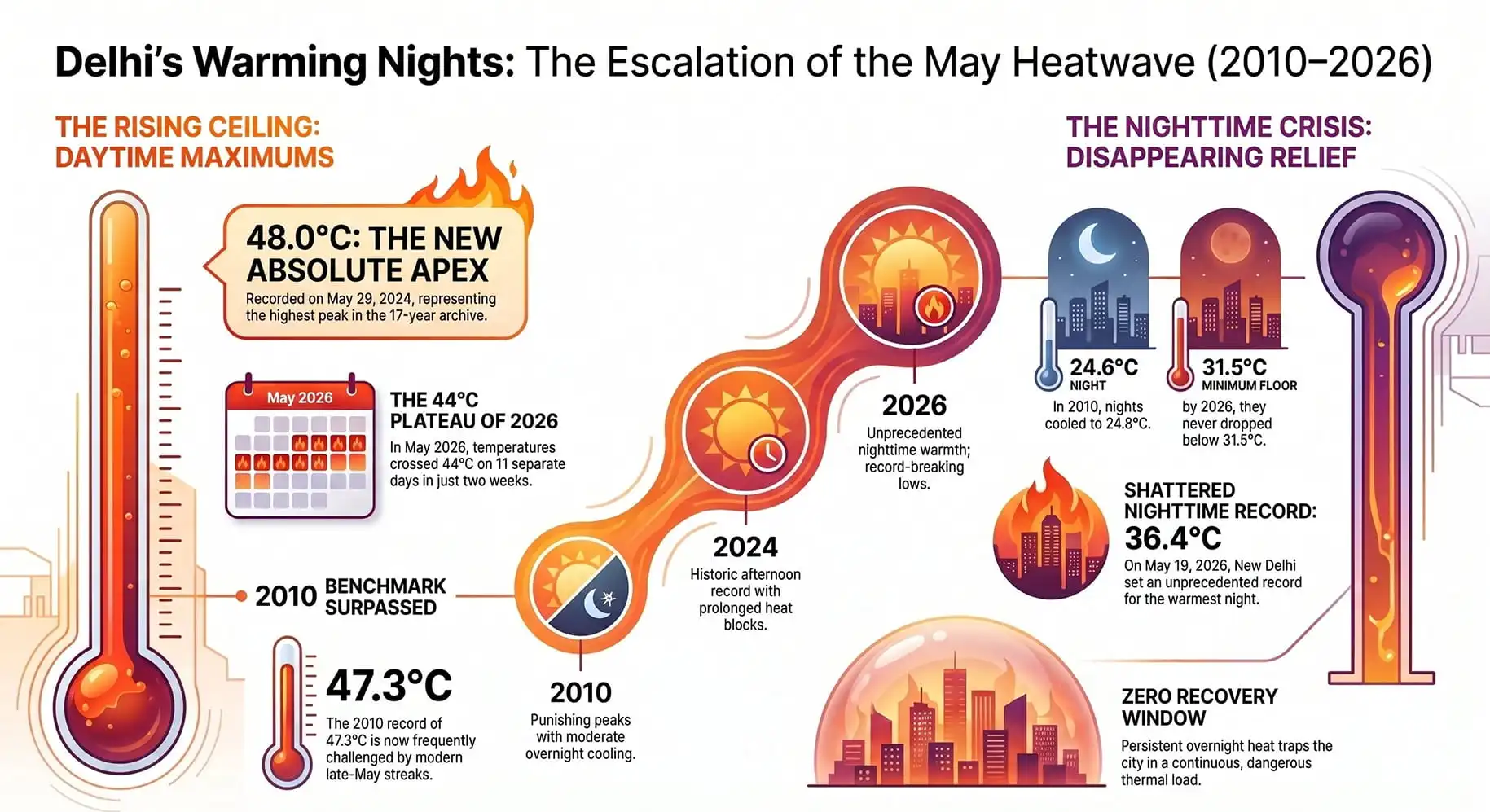
The 2010 Benchmark: Early in the timeline, May 26, 2010, set a severe afternoon high of 47.3°C.
-
The 48°C Apex: The absolute maximum temperature in this entire data archive was recorded on May 29, 2024, when the city reached a staggering 48.0°C. This capped off a relentless late-May streak where afternoons consistently stayed above 46°C.
-
The May 2026 Reality: The current 2026 season has maintained an intense high-heat plateau. Between May 11 and May 26, 2026, afternoon maximums crossed the 44°C threshold on 11 separate days, eventually peaking at a blistering 45.9°C on May 19, followed closely by 45.7°C on May 25.
2. The Nighttime Crisis: When the Recovery Window Closes in May
While blazing afternoons command attention, the most significant insight within the Delhi Summer Data archive is the rising floor of nighttime minimum temperatures. When nighttime temperatures remain elevated, the city’s infrastructure traps heat, preventing crucial overnight cooling.
The data reveals that May nights have shifted from uncomfortably warm to historically unprecedented:
-
The Historical Baseline: In May 2010, even when daytime temperatures breached 45°C, early-month nights regularly fell to a manageable 24.6°C (May 8), providing a vital recovery window.
-
The 35°C Barrier: In late May 2025, nighttime temperatures reached a temporary peak when the overnight low hit a stifling 35.7°C on May 28.
-
The Unprecedented May 2026 Surge: The current month has established a completely new baseline for overnight warmth. Between May 11 and May 26, 2026, the nighttime minimum temperature never dropped below 31.5°C. The crisis peaked on May 19, 2026, when New Delhi logged an astonishing nighttime minimum temperature of 36.4°C—breaking all previous overnight records in the dataset and ensuring the city remained trapped in afternoon-level heat even in the dead of night.
3. The Weather Paradox: Remembering Historical Outliers
The longitudinal Delhi Summer Data timeline demonstrates that peak summer is occasionally broken by dramatic, unseasonal atmospheric shifts.
-
The Massive 2021 Delhi Temperature Inversion: On May 19, 2021, an intense regional weather shift forced daytime temperatures down to an unprecedented 25.6°C. For a brief window, peak summer felt like late autumn.
-
The Mild May of 2023: May 2023 stood out as an exceptionally mild exception in the archive. The month began with a crisp morning low of 19.7°C on May 4, and afternoon heat rarely reached severe heatwave limits all month.
Longitudinal May Climate Overview (2010 – 2026)
By filtering the dataset purely for the month of May, the table below showcases the shifting boundaries of New Delhi’s peak summer climate over the last 17 years:
| Year | Absolute Max Temp (°C) | Date of Max Temp | Absolute Min Temp (°C) | Date of Min Temp | Climate Character of the Month |
| 2010 | 47.3°C | May 26 | 24.6°C | May 8 | Punishing daytime peaks paired with moderate overnight cooling. |
| 2013 | 46.4°C | May 23 | 23.8°C | May 2 | Severe late-month heatwave blocks touching the high 46s. |
| 2016 | 44.5°C | May 18 | 25.5°C | May 6 | Consistent mid-44s afternoon plateaus with stable overnight minimums. |
| 2021 | 40.3°C | May 27 | 21.7°C | May 20 | Highly anomalous; entirely disrupted by a major mid-month temperature inversion. |
| 2023 | 44.5°C | May 23 | 19.7°C | May 4 | Historically mild baseline, logging the lowest minimum floor in the database. |
| 2024 | 48.0°C | May 29 | 21.9°C | May 2 | Historic afternoon record peak; prolonged multi-day blocks consistently exceeding 46°C. |
| 2025 | 45.3°C | May 29 | 23.3°C | May 2 | Severe overnight baseline compression, recording a 35.7°C low on May 28. |
| 2026 (Current) | 45.9°C | May 19 | 24.9°C | May 5 | Unprecedented nighttime warmth; record-shattering 36.4°C minimum floor on May 19. |
Structural Takeaways for Climate Adaptation
The pure metrics of the Delhi Temperature Data archive prove that our understanding of summer heat must change. Heat mitigation strategies can no longer focus solely on managing afternoon conditions. With May minimum temperatures now regularly failing to cool below 31°C to 34°C for weeks at a time, the continuous thermal load on the city’s power grid, water infrastructure, and public health systems is immense. Addressing this persistent overnight heat retention through targeted urban planning—such as cool-roof materials, urban canopy expansions, and energy grid resilience—is now a critical necessity for managing the capital’s summer evolution.
 Shakshi
 Gyane Haobijam
 Manasvi Kumar