 Gyane Haobijam
India is in the midst of one of the world’s largest construction booms. From expressways cutting through farmland to metro tunnels burrowing under cities, from gleaming glass towers in Hyderabad to affordable housing colonies in Patna — construction is everywhere. But buried beneath the promise of progress is a serious, often ignored problem: the toxic air that construction activity generates every single day, contributing to the growing issue of Construction Air Pollution.
As we delve deeper into the issue, it becomes clear that Construction Air Pollution is a multifaceted problem that requires immediate attention.
Studies indicate that the levels of Construction Air Pollution can significantly affect vulnerable populations living nearby.
According to global research, construction and demolition activities contribute anywhere from 10% to 30% of total particulate matter (PM) emissions in urban areas. In Indian cities where multiple large projects run simultaneously — sometimes right next to residential colonies — the impact on air quality is dramatic, and the health consequences of Construction Air Pollution are real.
This blog takes a deep dive into what makes construction pollution so dangerous, who bears the brunt of it, what the data says, and what can actually be done about it.
Understanding Construction Air Pollution is crucial for urban planning and public health.
| 📊 Key Stat: Construction activities contribute up to 30% of PM10 and 20% of PM2.5 in highly urbanised areas, making it one of the top sources of air pollution in growing cities like Delhi, Mumbai, and Bangalore. |
1. What Is Construction Air Pollution?
The ongoing challenges posed by Construction Air Pollution must be addressed through collaborative efforts from all stakeholders.

Construction air pollution refers to harmful airborne particles, gases, and chemical compounds released during the building, renovation, or demolition of structures and infrastructure. Unlike vehicle emissions that have been regulated for decades, Construction Air Pollution is often poorly controlled, intermittent, and extremely localized — making it harder to monitor and enforce.
Operational guidelines should focus heavily on mitigating Construction Air Pollution at every stage of the project lifecycle.
It comes from a wide array of sources at a typical construction site:
- Earthmoving and excavation — digging releases massive amounts of soil dust
- Demolition of old structures — especially risky when asbestos or lead paint is present
- Cutting, grinding, drilling — of concrete, stone, bricks, and metal
- Diesel-powered heavy machinery — excavators, bulldozers, cranes, compactors
- Transport vehicles — trucks hauling materials in and out of site
- Burning of waste materials — a common but illegal practice on many Indian sites
- Application of coatings, adhesives, and sealants — releasing VOCs into the air
2. The Major Pollutants and Their Health Risks
Construction sites produce a dangerous cocktail of pollutants. Below is a breakdown of the most significant ones:
| Pollutant | Source | Health Impact | Risk Level |
| PM2.5 & PM10 | Cutting, drilling, demolition | Respiratory disease, lung damage | High |
| Silica Dust | Concrete/stone cutting | Silicosis, lung cancer | Very High |
| Volatile Organic Compounds | Paints, adhesives, solvents | Headaches, liver damage, cancer | Moderate–High |
| Diesel Exhaust | Heavy machinery, generators | Heart disease, cancer | High |
| Asbestos Fibers | Old building demolition | Mesothelioma, lung cancer | Extreme |
| Carbon Monoxide | Internal combustion engines | Poisoning, cardiac effects | Moderate |
| Nitrogen Oxides (NOx) | Diesel engines, burning | Smog, respiratory illness | Moderate–High |
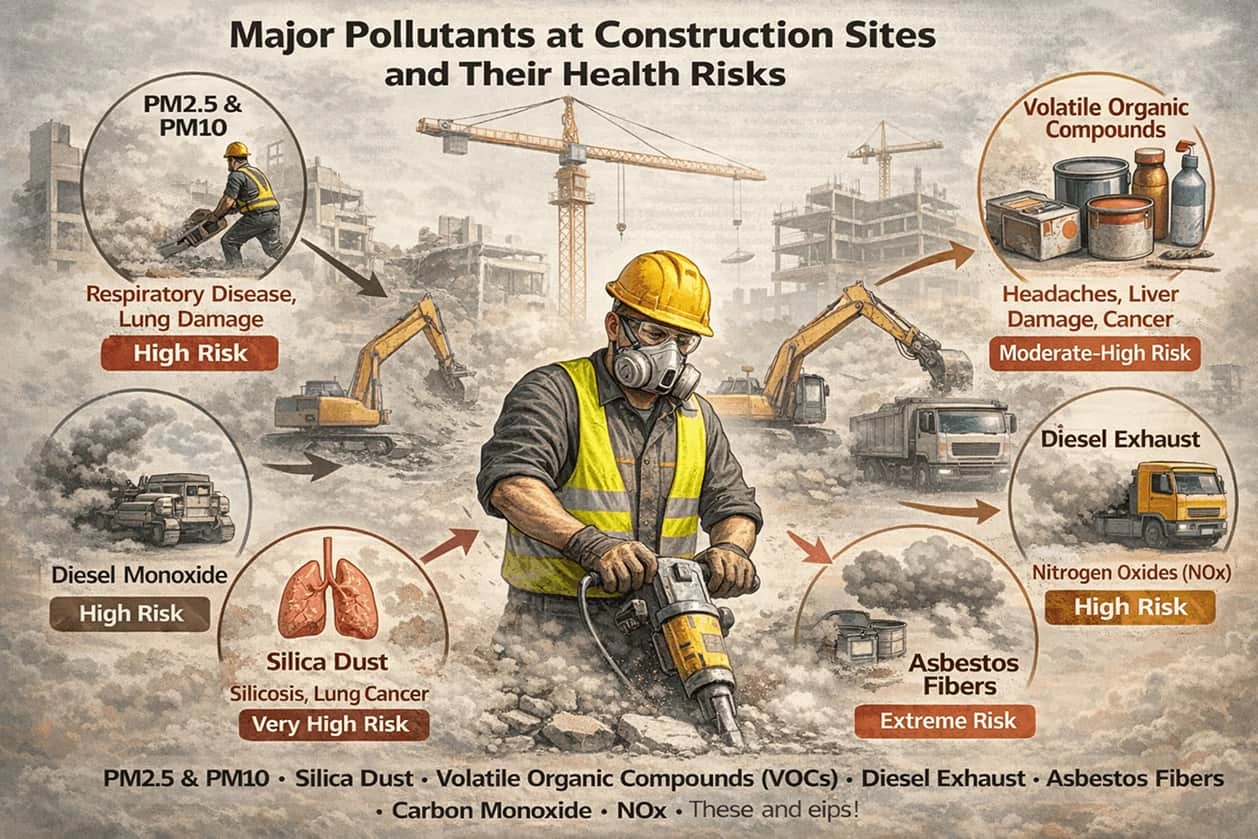
Of these, PM2.5 and crystalline silica dust are the most universally dangerous. PM2.5 particles are so fine they bypass the body’s natural defenses entirely and lodge deep in lung tissue, eventually entering the bloodstream. Silica dust, released when cutting concrete or stone, causes silicosis — an irreversible and often fatal lung disease — after prolonged exposure.
Awareness about the health impacts of Construction Air Pollution is critical among workers and residents alike.
3. Who Is Most at Risk?
Construction Workers
To combat Construction Air Pollution, we need effective strategies that prioritize the health and safety of everyone affected.
They are the most directly exposed population. Studies across India show that construction workers experience PM2.5 exposures 5–10 times above WHO guidelines during their working hours. Most work without adequate protective equipment, and many are migrant laborers with little awareness of or access to occupational health services.
Nearby Residents
People living, working, or studying within 500 metres of a major construction site experience significantly elevated pollution levels, especially during dry windy weather. Schools near construction zones are a serious concern, with children’s developing lungs highly vulnerable to particulate exposure.
Children and the Elderly
Children breathe faster relative to their body size, meaning they inhale proportionally more polluted air. The elderly, especially those with pre-existing conditions like COPD, asthma, or cardiovascular disease, face life-threatening risks from elevated construction dust.
Pregnant Women
Research has linked high PM2.5 exposure during pregnancy to low birth weight, preterm delivery, and developmental issues in newborns. Construction zones near maternity hospitals or dense residential areas pose a compounded risk.
It is essential to recognize Construction Air Pollution as a significant urban health challenge that cannot be overlooked.
| 🏥 Health Impact Snapshot: Prolonged exposure to construction dust is associated with: silicosis, chronic bronchitis, COPD, asthma, lung cancer, cardiovascular disease, and reduced life expectancy. In India, millions of construction workers remain unprotected. |
4. The India Context: A Nation Under Construction
India presents a unique and challenging landscape when it comes to construction pollution:
- India is the world’s second-largest construction market, with the sector valued at over $500 billion.
- The country adds approximately 700–900 million sq. ft. of new construction every year.
- Delhi alone has thousands of active construction sites at any given point — many operating without approved dust mitigation measures.
- During winter months, the combination of construction dust, crop stubble burning, and thermal inversions creates catastrophic air quality in the Indo-Gangetic Plain.
- Real-time AQI monitors near active construction corridors in cities like Gurugram, Noida, and Navi Mumbai consistently record PM10 values of 300–600 µg/m³ — far above the safe limit of 100 µg/m³.
A 2023 study by IIT Delhi found that road construction and associated heavy machinery accounted for nearly 18% of Delhi’s wintertime PM2.5 — more than the contribution of stubble burning on many days.
5. Regulations: What the Law Says
India does have rules around construction dust. The primary regulatory frameworks include:
- The Environment Protection Act (1986) and National Ambient Air Quality Standards (NAAQS)
- CPCB (Central Pollution Control Board) Guidelines for Dust Control at Construction Sites
- Graded Response Action Plan (GRAP) under the Commission for Air Quality Management (CAQM) — applicable in Delhi-NCR
- National Green Tribunal (NGT) orders requiring dust control measures at sites above a certain size
Under GRAP Stage 3 and 4, large construction projects in Delhi NCR are banned entirely. Projects above 500 sq. metres must register online, install CCTVs, and deploy dust mitigation measures including anti-smog guns, water sprinkling, green netting, and on-site air quality monitors.
However, enforcement remains patchy. Many smaller sites fly under the radar, and inspections are often inadequate. Self-reporting requirements are frequently ignored, especially by smaller contractors.
Collectively, we can tackle Construction Air Pollution by supporting initiatives aimed at improving air quality.
6. Effective Dust Control Measures
The good news is that construction dust is one of the more controllable sources of air pollution. When properly implemented, the following measures can reduce site emissions by 60–80%:
Certain regulations exist to manage Construction Air Pollution, yet enforcement remains a critical gap that must be filled.
Water Sprinkling & Dust Suppression
Regular water spraying on active excavation areas, unpaved roads, and stockpiled materials is one of the most cost-effective dust control methods. Anti-smog guns that project a fine water mist can suppress PM10 over a radius of 50–100 metres.
Green Netting & Barricading
Covering construction sites with fine mesh green nets reduces dust dispersal significantly. Proper hoarding (boundary walls) of at least 3 metres height must be mandatory for all urban sites.
Covered Material Transport
Trucks carrying sand, gravel, cement, or debris must be covered with tarps. Wheel-washing facilities at site exits prevent soil from being tracked onto public roads — a major secondary dust source.
Equipment Upgrades
Switching from BS-III to BS-VI diesel equipment dramatically reduces both particulate and NOx emissions. Electric or hybrid construction machinery, increasingly available in India, should be incentivised.
Implementing robust dust control measures can lead to a substantial reduction in Construction Air Pollution levels.
The community plays a vital role in minimizing Construction Air Pollution through proactive measures and awareness.
Wet Cutting Techniques
For cutting concrete, stone, or metal, wet cutting methods (using water to suppress dust at the source) reduce airborne silica and PM10 by over 90% compared to dry cutting.
Real-Time AQI Monitoring
Deploying compact IoT-based air quality monitors like those offered by Prana Air at site boundaries allows contractors and regulators to monitor pollution levels in real time, triggering immediate corrective action when thresholds are breached.
| 💡 Pro Tip for Site Managers: Installing a boundary AQI monitor from Prana Air (available via aqi.in) enables real-time PM2.5, PM10, and VOC tracking at your construction site. Data feeds directly to the web dashboard — providing compliance evidence and early warnings before dust becomes a regulatory or community problem. |
7. The Role of Technology and Data
Air quality data is transforming how construction pollution is tracked and controlled. Platforms like AQI.in aggregate data from thousands of sensors across India, making it possible to:
- Identify pollution hotspots correlated with active construction corridors
- Compare air quality before, during, and after construction phases
- Alert residents in real time when nearby site activity causes AQI to spike
- Provide regulators with evidence for enforcement and penalty actions
- Help contractors demonstrate compliance with dust norms via dashboard reports
The combination of low-cost sensors, IoT connectivity, and open data platforms has made granular construction site monitoring feasible even for medium-sized projects in Tier-2 cities. What was once the preserve of large infrastructure projects can now be deployed by any contractor willing to invest a few thousand rupees per month.
8. What Can You Do as a Citizen?
You don’t have to be a contractor or policymaker to make a difference:
- Report non-compliant construction sites to your local CPCB/SPCB online portal or the Sameer App.
- Use AQI.in or the AQI mobile app to monitor real-time pollution near your home and identify when nearby construction is spiking PM levels.
- Wear N95 masks (not surgical masks) when outdoors near construction zones — they filter out 95% of PM2.5 particles.
- Keep windows closed during peak construction hours (usually 8 AM – 6 PM) and use an indoor air purifier if you live near an active site.
- Advocate within your Resident Welfare Association (RWA) for proactive monitoring and dialogue with nearby construction contractors.
Conclusion: Progress Without Poison
India’s infrastructure development is essential and inevitable. Roads, metros, homes, schools, hospitals — all of it must be built. But there is no reason why construction cannot happen more cleanly. The technology exists. The regulations (largely) exist. What is missing is consistent enforcement, greater awareness, and a cultural shift among contractors that views dust control not as a burden but as a basic professional responsibility.
Every construction site that installs dust netting, sprinkles water, covers trucks, and monitors air quality is contributing to a city that is liveable not just when the building is finished — but while it is being built.
As responsible citizens, we must engage in conversations about Construction Air Pollution and its impact on our health. Ultimately, addressing Construction Air Pollution should be a shared priority for all levels of society. In summary, the discourse around Construction Air Pollution is crucial for shaping healthier urban environments. Together, we can strive for progress without the adverse effects of Construction Air Pollution.
 Divya Singh
 Deepshikha Deb
 Poorna Khanna
 Shakshi
 Shikhar Verma
 Nikita Kaul
 Livia Machado
 Ajay
Ajay Caroline Hasl
 Rahul
Rahul