 Anwesha
The National Capital Region (NCR) witnessed a sharp and sudden increase in visible smog today, marking a clear case of a sudden smog rise across the region. Real-time data from AQI.in indicated rapid deterioration in air quality, with several monitoring locations across the NCR recording levels in the Severe to Hazardous range within a short span of time.
Community-level air quality data highlighted strong variation across neighbourhoods in Delhi-NCR, indicating that stagnant weather conditions led to hyperlocal pollution spikes rather than a uniform city-wide increase.
Why Smog Appeared So Suddenly
Air pollution, particularly fine particulate matter such as PM2.5, is released continuously from urban sources including vehicular traffic, construction activity, road dust, industrial operations and regional transport of pollutants. On days with favourable weather, these pollutants disperse both horizontally and vertically, limiting visible accumulation.
During a sudden smog rise, this dispersion mechanism weakens. Pollutants remain trapped near the surface, causing concentrations to increase rapidly. As a result, the air can turn visibly hazy or smoky within a short time window, making the deterioration appear abrupt to residents.
Meteorological Conditions Driving Today’s Smog Episode
Unfavourable meteorological conditions were the primary trigger behind today’s sharp air quality deterioration.
Low wind speeds across the region significantly reduced horizontal air movement, allowing particulate matter to accumulate instead of dispersing. Wind plays a critical role in clearing polluted air, and when it weakens, even routine emissions can lead to a rapid build-up of pollution.
In addition, night-time cooling led to the formation of temperature inversion conditions. During inversion, cooler and denser air near the ground becomes trapped beneath a warmer air layer above. This suppresses vertical mixing and prevents pollutants from rising and dispersing into the upper atmosphere.
It is important to note that temperature inversion does not require extreme cold. Even moderate winter cooling can be sufficient to create inversion layers, particularly when wind speeds are low. Once inversion sets in, pollutants concentrate close to breathing level, intensifying smog formation.
Humidity further aggravated conditions by increasing smog visibility. Fine particulate matter absorbs moisture under humid conditions, increasing particle size and enhancing light scattering. This makes the air appear denser and reduces visibility, even when pollutant levels rise steadily.
Pollution Load Already Present
Urban regions typically carry a high baseline pollution load during winter months. Vehicular emissions remain a dominant contributor, while construction activity and resuspended road dust add significantly to particulate concentrations. Regional transport of pollutants from surrounding areas further adds to the overall pollution burden.
AQI.in data from preceding days showed that particulate levels were already elevated before today’s smog episode. The sudden smog rise occurred when unfavourable weather conditions prevented dispersion, allowing existing pollution to accumulate rapidly and push air quality into severe categories.
What Today’s AQI.in Data Shows
Real-time monitoring data from AQI.in confirms the severity of today’s pollution episode. Community air quality monitors recorded hazardous peaks at several locations, highlighting strong spatial variation in pollution levels.
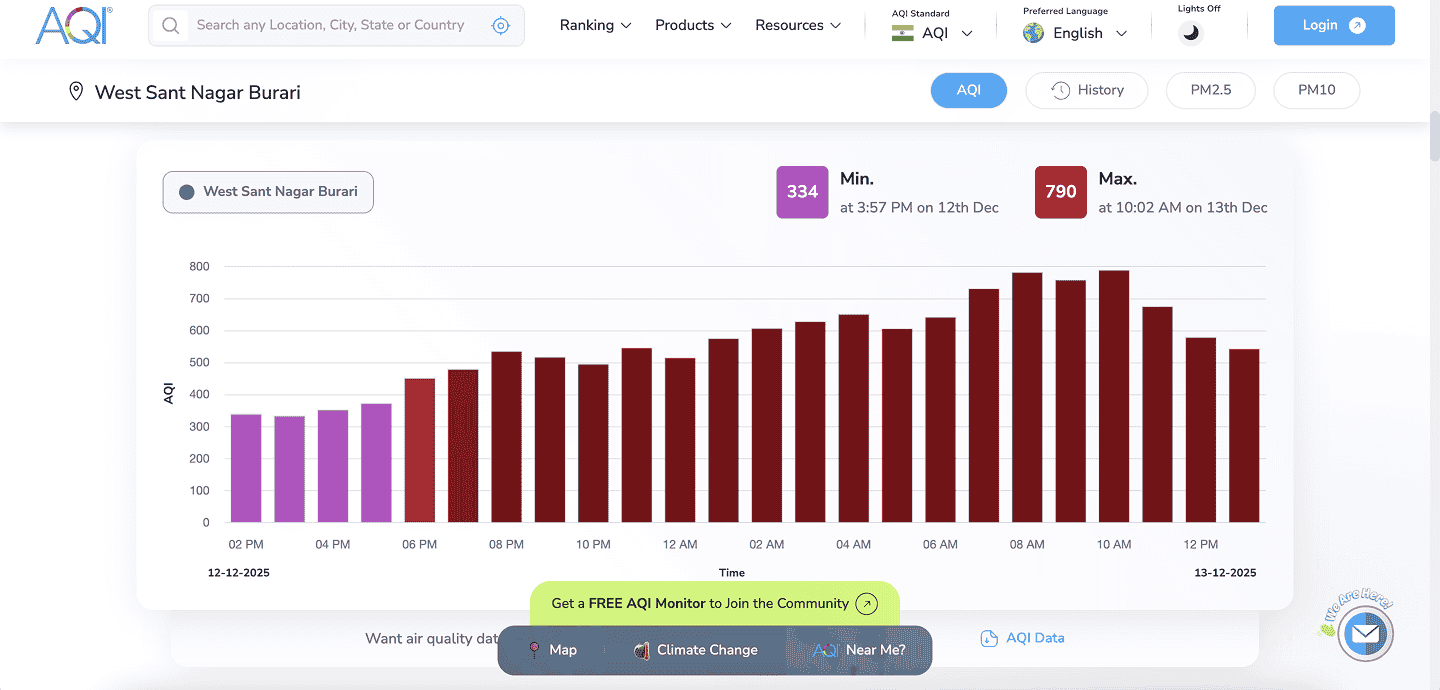
In Saraswati Marg, AQI values peaked at 727 during the morning hours. West Sant Nagar, Burari recorded an even higher peak of 790, while Noida saw AQI levels touching 733. These readings indicate extremely poor air quality in multiple neighbourhoods and demonstrate how stagnant weather conditions led to uneven but severe pollution accumulation across the region.
PM2.5 concentrations remained far above safe limits at these locations, reinforcing the link between visible smog and elevated fine particulate pollution.
Role of Community Monitors and Hyperlocal Insights
AQI.in’s network of community air quality monitors played a critical role in capturing today’s pollution spike at a hyperlocal level. Unlike city-wide averages, community monitors reveal sharp differences between neighbourhoods, allowing pollution hotspots to be identified in real time.
During today’s smog episode, community monitor data clearly showed how stagnant atmospheric conditions caused rapid and uneven accumulation of particulate matter across different areas. This hyperlocal visibility is essential for understanding actual exposure risks faced by residents.
Impact on Visibility and Public Health
As particulate matter accumulated near ground level, visibility declined sharply across several urban pockets. Dense smog reduced clarity on roads and residential streets, reflecting the high concentration of fine particles suspended in the air.
PM2.5 is of particular concern because of its ability to penetrate deep into the lungs and enter the bloodstream. Elevated levels are associated with respiratory irritation, breathing discomfort and increased cardiovascular stress. Prolonged exposure during severe pollution episodes can aggravate existing health conditions, especially among children, the elderly and individuals with respiratory illnesses.
Advisory for Residents
In view of the prevailing air quality conditions, residents are advised to:
- Monitor local AQI updates regularly
- Limit time spent outdoors
- Avoid strenuous physical activity in open areas
- Use indoor air purification systems where availableWear protective masks when stepping outside
- Reducing exposure during peak pollution hours can help lower immediate health risks.
What to Expect Next
Meteorologists warn that as winter conditions deepen, air quality may deteriorate further over the coming days if low wind speeds and inversion conditions persist. Continued atmospheric stagnation can prolong smog episodes until weather patterns shift and dispersion improves.
Today’s episode demonstrates how a sudden smog rise during winter is often driven as much by meteorological conditions as by emission levels. Continuous AQI monitoring and timely precautionary measures remain essential during periods of weather-induced air stagnation.
 Shakshi
 Gyane Haobijam
 Nikita Kaul
 Nandini
 Divya Singh
 Poorna Khanna